RENOIR REDESCUBIERTO: IMPORTANTE EXPOSICIÓN DESVELA EL PROCESO DE DIBUJO DEL IMPRESIONISTA TRAS UN SIGLO DE SILENCIO
RENOIR REDISCOVERED: MAJOR EXHIBITION UNLOCKS IMPRESSIONIST MASTER’S DRAWING PROCESS AFTER A CENTURY OF SILENCE
OCTOBER 17, 2025 — Pierre-Auguste Renoir, the luminous French Impressionist, is stepping back into the spotlight 150 years after the movement’s inception, not for his iconic canvases, but for the intimate foundation of his art: his drawings. A major traveling exhibition, “Renoir Drawings,” featuring over 100 works on paper, opens today at the Morgan Library & Museum in New York, marking the first comprehensive showcase of his graphic art in over a century.
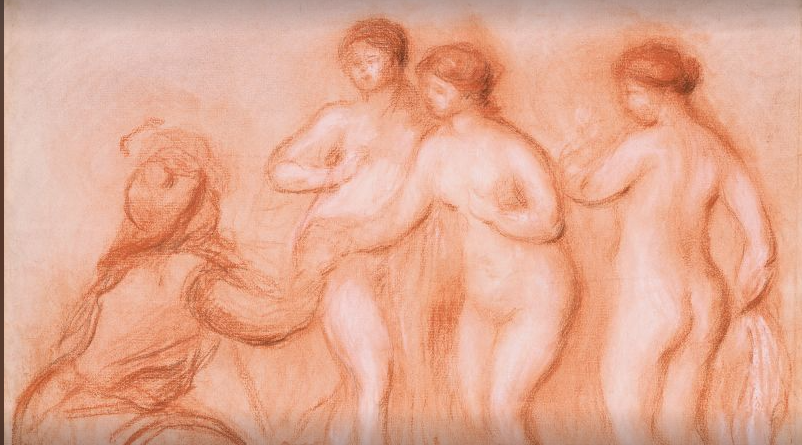
This exhibition shatters the perception that Renoir, known for his spontaneous, loose-brushwork landscapes and society portraits, rarely drew. On the contrary, Renoir drew extensively throughout his life, using media from pencil and ink to red chalk and watercolor, documenting everything from academic studies to intimate family sketches. With the exception of his main Impressionist period, drawing was, in his own words, his “research and his material.” The idea for the exhibition was sparked by a chance encounter years ago, when Morgan Library Director Colin Bailey spotted a large 1886–1887 red and white chalk study for “The Great Bathers” at a dinner party. That drawing, later donated by cultural philanthropist Drue Heinz, became the catalyst for the show.
The exhibition’s main goal is to peel back the layers of Renoir’s creative process. For the first time, several of his preparatory drawings will be reunited with their related major paintings. Notably, all seven surviving preparatory drawings for his seminal painting, The Great Bathers (1884-1887), will be displayed alongside the painting itself (on loan from the Philadelphia Art Museum, thanks to a recent easing of donor restrictions). Similarly, the Musée d’Orsay’s “Dance in the Country” (1883) will be displayed with its preliminary sketches.
The drawings trace the evolution of Renoir’s style, from his rigorous training at the École des Beaux-Arts to his highly disciplined return to preparatory sketching in the 1880s, a period marked by a shift toward a sharper, more linear style and his adoption of blendable red chalk. By showing these studies alongside the final works, Bailey hopes viewers will see that Renoir’s painting process was “more deliberate, more calculated… and more of a struggle” than his carefree surfaces suggest.
For modern viewers, Renoir’s focus on the “intimate and joyful moments of everyday life” still radiates warmth and optimism, providing, as Bailey notes, “the sense of the delights of being free and young and in love in Paris.”
(Spanish) RENOIR REDESCUBIERTO: IMPORTANTE EXPOSICIÓN DESVELA EL PROCESO DE DIBUJO DEL IMPRESIONISTA TRAS UN SIGLO DE SILENCIO
17 DE OCTUBRE DE 2025 — Pierre-Auguste Renoir, el luminiscente impresionista francés, vuelve a ocupar el centro de atención 150 años después del inicio del movimiento, no por sus icónicos lienzos, sino por el cimiento íntimo de su arte: sus dibujos. Una importante exposición itinerante, “Renoir Drawings,” que presenta más de 100 obras en papel, se inaugura hoy en el Morgan Library & Museum de Nueva York, marcando la primera muestra exhaustiva de su arte gráfico en más de un siglo.
Esta exposición rompe con la percepción de que Renoir, conocido por sus paisajes espontáneos y su pincelada suelta, dibujaba raramente. Por el contrario, Renoir dibujó extensamente a lo largo de su vida, utilizando medios desde lápiz y tinta hasta tiza roja y acuarela, documentando todo, desde estudios académicos hasta bocetos familiares íntimos. Con la excepción de su principal período impresionista, el dibujo fue, en sus propias palabras, su “investigación y su material”.
La idea de la exposición surgió de un encuentro casual hace años, cuando el director de la Morgan Library, Colin Bailey, vio un gran estudio de tiza roja y blanca de 1886-1887 para “Las Grandes Bañistas” en una cena. Ese dibujo, donado más tarde por la filántropa cultural Drue Heinz, se convirtió en el catalizador de la muestra.
El principal objetivo de la exposición es desvelar las capas del proceso creativo de Renoir. Por primera vez, varios de sus dibujos preparatorios se reunirán con sus pinturas principales relacionadas. En particular, los siete dibujos preparatorios supervivientes de su pintura seminal, Las Grandes Bañistas (1884-1887), se exhibirán junto a la pintura misma (cedida por el Museo de Arte de Filadelfia, gracias a una reciente flexibilización de las restricciones de los donantes). De manera similar, “Baile en el Campo” (1883) del Musée d’Orsay se mostrará con sus bocetos preliminares.
Los dibujos trazan la evolución del estilo de Renoir, desde su riguroso entrenamiento en la École des Beaux-Arts hasta su regreso altamente disciplinado al boceto preparatorio en la década de 1880, un período marcado por un cambio hacia un estilo más nítido y lineal y su adopción de la tiza roja, más difuminable. Al mostrar estos estudios junto a las obras finales, Bailey espera que los espectadores vean que el proceso de pintura de Renoir fue “más deliberado, más calculado… y más una lucha” de lo que sugieren sus despreocupadas superficies.
Para los espectadores de hoy, el enfoque de Renoir en los “momentos íntimos y alegres de la vida cotidiana” todavía irradia calidez y optimismo, proporcionando, como señala Bailey, “la sensación de las delicias de ser libre, joven y estar enamorado en París.